Office Booths vs Meeting Rooms: Which Does Your Office Actually Need?
Walk through most South African offices today and you will find the same problem playing out in different forms. The boardroom is booked solid for back-to-back video calls that could have been handled at a desk. The open-plan floor is too noisy for focused work. And the one or two small meeting rooms are either constantly occupied or entirely unused, depending on the day.
The question of office booths versus meeting rooms has become one of the most practical decisions facing businesses undergoing a fit-out or renovation in Cape Town, Durban, and across South Africa. Both serve important functions. Both have real limitations. And most organisations — once they understand the difference — need some version of each.
This guide explains what sets them apart, when each solution works best, and how to strike the right balance in your own office layout.
What Are Office Booths?
Office booths, also called acoustic pods, phone booths, focus pods, or huddle booths depending on their size, are semi-enclosed or fully enclosed structures installed within an open-plan office floor. They are designed to provide a degree of acoustic privacy and visual separation without permanently dividing the space.
They come in several formats, each suited to a different use:
Single-person phone booths
Compact, fully enclosed pods for calls, video meetings, or focused individual work. Typically include a seat, work surface, ventilation, and power outlets. Designed for one person for short to medium periods — usually under 60 minutes.
Two-to-four person huddle booths
Semi-enclosed or fully enclosed booths for small team conversations, informal reviews, or quick collaborative work. These are the most versatile format and the one most commonly specified in office fit-outs across South Africa.
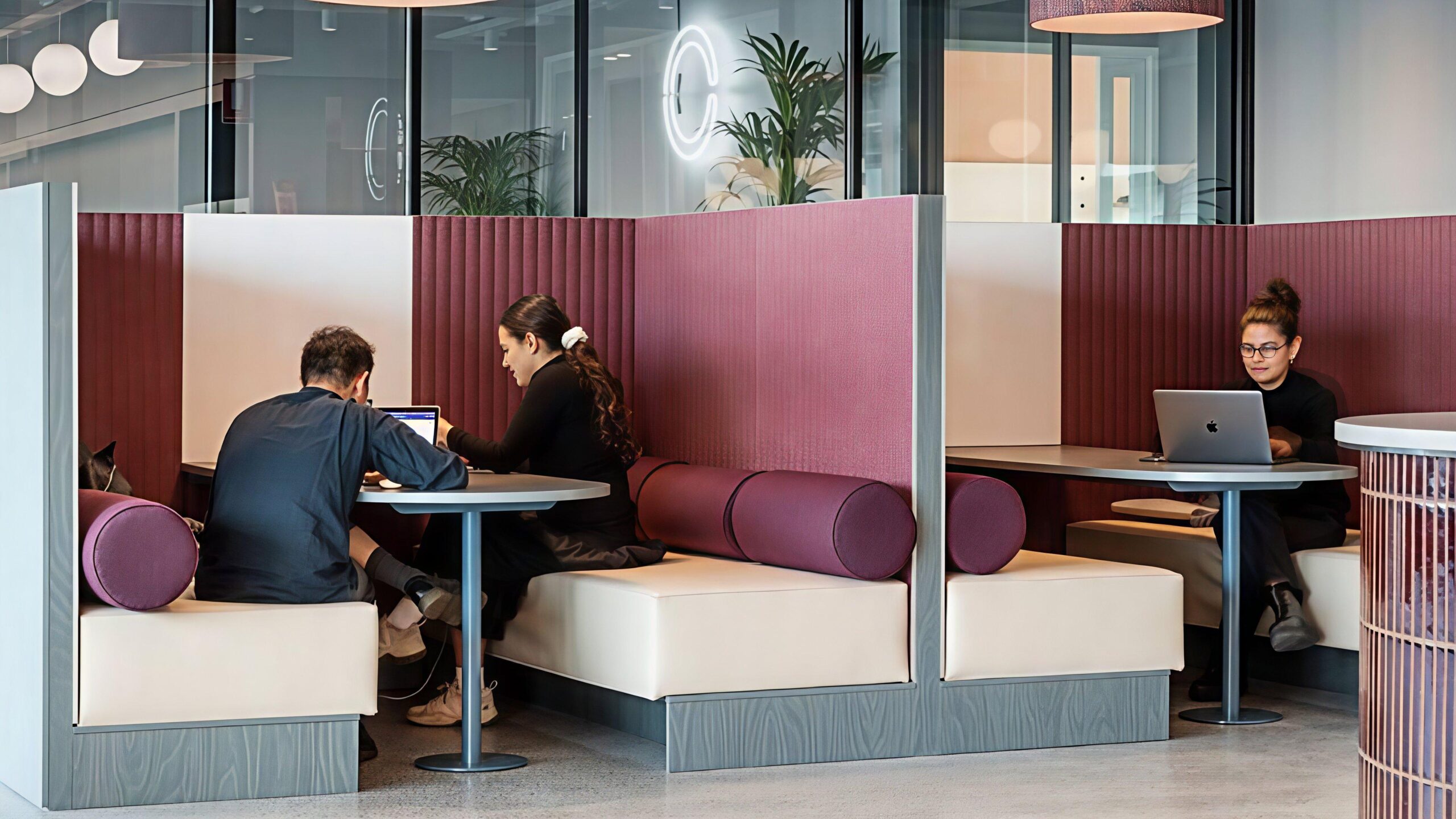
Lounge-style booths
Open-backed, high-sided seating units that create a sense of enclosure without full acoustic separation. More social in character — suited to informal catch-ups, breakout conversations, or relaxed working rather than calls or sensitive

What Are Meeting Rooms?
A meeting room is a permanently constructed, enclosed space, four solid or glazed walls, a door, a ceiling, dedicated to meetings, presentations, calls, or confidential conversations. Unlike booths, meeting rooms are part of the building’s permanent structure and require planning, construction, and fit-out to implement. Meeting rooms typically range in size from small two-person rooms (sometimes called focus rooms or quiet rooms) through mid-sized collaborative spaces seating six to eight, up to full boardrooms that may seat twelve to twenty or more. The defining characteristic of a meeting room is its permanence and its level of acoustic and visual privacy. A well-built meeting room with proper acoustic treatment and full-height partitions provides total separation from the rest of the office, something no booth, however well-engineered, can fully replicate.
| Factor | Office Booths | Meeting Rooms |
|---|---|---|
| Acoustic privacy | Good to very good — suited to most calls and focused work | Excellent — full separation, suitable for confidential conversations |
| Visual privacy | Partial to full, depending on design | Full — solid or manifestation-glazed walls |
| Floor space | Low — placed within existing open-plan area | High — dedicated floor area, typically 8–25 m² per room |
| Cost | Lower — modular units, minimal construction | Higher — drylining, glazing, electrical and AV required |
| Flexibility | High — can be moved or reconfigured as needs change | Low — permanent structures are costly to alter |
| Booking required | Usually no — available on demand | Yes — typically booked in advance |
| Best for | Calls, focus work, quick huddles, spontaneous use | Client meetings, presentations, board sessions, HR conversations |
| Capacity | 1–4 people | 2–20+ people |
When Office Booths Are the Right Choice
Acoustic office booths make most sense when your primary challenge is giving individuals or small groups a degree of separation from the open-plan floor, without permanently reducing your usable workspace or committing to the cost of constructed rooms. In the Cape Town and Durban offices Proturnkey works with most frequently, booths have become a standard feature of any open-plan fit-out — not as an alternative to meeting rooms, but as a complement to them.
| Factor | Office Booths | Meeting Rooms |
|---|---|---|
| Acoustic privacy | Good to very good — suited to most calls and focused work | Excellent — full separation, suitable for confidential conversations |
| Visual privacy | Partial to full, depending on design | Full — solid or manifestation-glazed walls |
| Floor space | Low — placed within existing open-plan area | High — dedicated floor area, typically 8–25 m² per room |
| Cost | Lower — modular units, minimal construction | Higher — drylining, glazing, electrical and AV required |
| Flexibility | High — can be moved or reconfigured as needs change | Low — permanent structures are costly to alter |
| Booking required | Usually no — available on demand | Yes — typically booked in advance |
| Best for | Calls, focus work, quick huddles, spontaneous use | Client meetings, presentations, board sessions, HR conversations |
| Capacity | 1–4 people | 2–20+ people |
When Dedicated Meeting Rooms Are Essential
There are situations where a booth, however well designed, simply will not do. Meeting rooms are not becoming obsolete; they are becoming more purposeful. The businesses we see getting the most value from their meeting rooms are those that have stopped treating them as general-purpose spaces and started designing them for specific functions.
A client presentation room is not the same as a strategy workshop space. A boardroom is not the same as an HR interview room. Designing each for its primary purpose, with the right acoustic performance, technology, furniture configuration, and visual treatment, makes a material difference to how well those rooms are used.
Meeting rooms remain essential for: client-facing interactions where the setting communicates professionalism; sensitive conversations that require full acoustic and visual privacy; presentations or training sessions with groups larger than four; board meetings and executive discussions; and any setting where the physical environment needs to reflect the seriousness of what is taking place.
The Most Effective Offices Use Both — Intentionally
The most common mistake South African businesses make when planning a new office fit-out is treating booths and meeting rooms as competing options. They are not. They serve fundamentally different needs, and the offices that function best are those that provide a genuine range of space types — from fully open workstations through to semi-private booths and fully enclosed rooms — and allow staff to choose the setting that fits the task.
A useful rule of thumb: for every 20–25 workstations, most organisations benefit from two to three single-person phone booths, one to two huddle booths for small groups, and at least one fully enclosed meeting room. This ratio shifts depending on how client-facing your business is and how frequently your teams need to collaborate versus work independently.
What matters most is not the ratio — it is the decision-making process. Start with how your teams actually work, not with a floor plan. Understand which meetings are happening in the wrong space, where noise is causing the most disruption, and where your meeting rooms are either overbooked or barely used. Those answers should drive your specification.
This is the approach Proturnkey takes at the start of every office fit-out and renovation in Cape Town, Durban, and across South Africa. Before we make a single design recommendation, we spend time understanding how the business operates — because the most expensive fit-out mistake is building the wrong spaces for your team.

Frequently Asked Questions
How much do office booths cost in South Africa?
Can office booths replace meeting rooms entirely?
How many meeting rooms does an office of 50 people need?
Are office booths worth the investment?
What is the difference between an office booth and a phone pod?
Planning an office fit-out in Cape Town or Durban?
Whether you are starting from scratch or rethinking an existing space, Proturnkey’s design team can help you identify the right mix of open plan, booth, and meeting room space for how your organisation actually works. With offices in Cape Town and Durban and projects delivered across South Africa, we bring over 15 years of commercial interior expertise to every fit-out and renovation we take on.